




Available For Work


You're Losing Users Before They Ever See Your Product
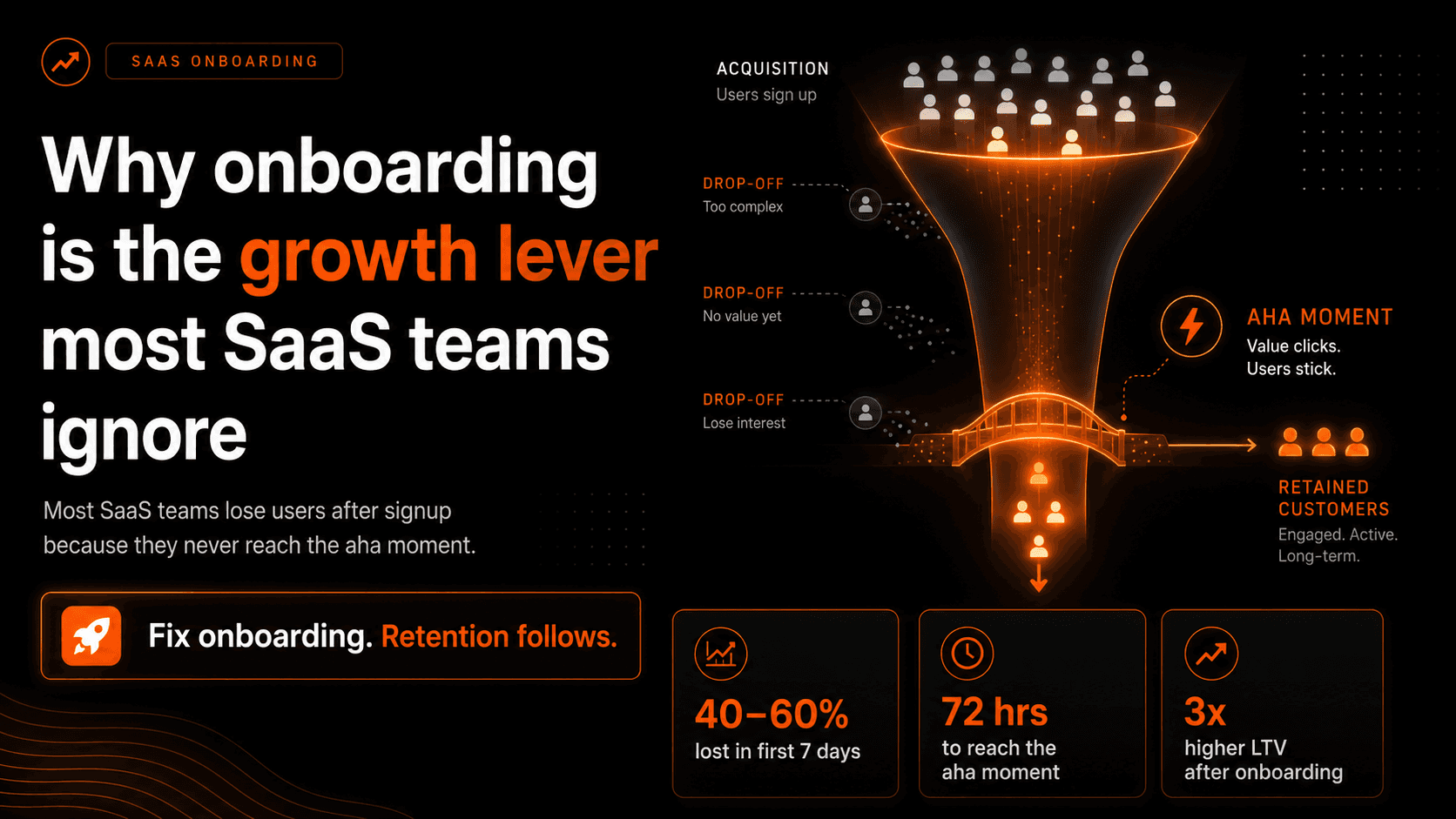
There's a pattern I've seen repeatedly across SaaS companies at every stage. The growth team runs a great campaign. Signups spike. The whole company celebrates. Then someone checks retention a week later and the number is awful.
Forty percent gone. Sometimes fifty. Sometimes sixty. Users who cost real money to acquire, gone before they ever saw the value of the product.
The instinct is to look outward due to bad targeting, wrong messaging, and misaligned positioning. And sometimes those are real problems. But more often than not, the leak is downstream. It's onboarding.
The cruel irony is that companies keep spending on acquisition to replace the users they're losing rather than fixing the experience that's causing them to leave.
The aha moment
Every product has a moment where the value becomes undeniable. The spreadsheet that auto-fills the report. The first message sent and replied to. The dashboard that just shows you exactly what you needed to see. That's the aha moment.
Users who reach it tend to stay. Users who don't, leave. It's that binary. If the answer is no, something in the next five elements is broken.
Key insight
Users don't churn because your product is bad. They churn because they never understood it well enough to care. Onboarding is the bridge between signing up and truly using the product.
The job of onboarding is simple to state and hard to execute: get every new user to their aha moment as fast as possible. Every tooltip, welcome email, empty state, and progress indicator should exist in service of that goal. If it doesn't accelerate the path to value, it's friction.
What good onboarding actually does
The surface benefit is obvious: users learn the product faster. But the real impact runs much deeper.
It shapes lifetime behavior
The actions a user takes in their first session tend to define how they interact with the product forever. Onboarding lets you be intentional about which behaviors you reinforce. Done well, it nudges users toward the habits that correlate with long-term retention — not through manipulation, but by removing friction from the path to value.
It reduces support overhead
When users are well-guided from the start, they don't need to file tickets asking how to do basic things. Your team spends less time firefighting. Cost per customer drops. And the product quality signal improves because the support queue is full of real edge cases, not onboarding confusion.
It earns the upgrade
For freemium and trial-based products, onboarding is your entire sales motion. There's no demo, no sales call, no proposal. Just the product. If users don't feel clear, genuine value before they hit the paywall, they won't cross it. Onboarding is where that conviction gets built or lost.
Higher activation rates and faster time-to-value
Lower early churn and better week-1 retention
Fewer support tickets and lower cost to serve
Better freemium-to-paid conversion rates
Higher LTV through early habit formation
The competitive moat nobody builds
Features get copied. Pricing gets matched. Distribution advantages erode over time. But a thoughtful onboarding experience that consistently makes users feel capable and confident? That's genuinely hard to replicate.
It lives in the culture of the product team. In how deeply the company understands its users. In dozens of small decisions made through months of iteration and data. You can't reverse-engineer it from the outside.
In crowded SaaS categories where the core feature sets have converged, onboarding is increasingly one of the clearest differentiators. It's where users decide if this product is for people like them.
The real question
What would your retention look like if every new user reliably reached their aha moment in the first session? That number is your ceiling. Onboarding is how you get closer to it.
Where to start
If you're not sure where your onboarding is failing, start at the aha moment. What is the single action a user takes that best predicts they will stay long-term? Find it in your data. It's almost always there.
Then map the path from signup to that action. Count every step and every decision point. For each one, ask: is this necessary for the user, or is it necessary for us?
Most onboarding flows are too long, too feature-centric, and too focused on showing users what the product can do rather than helping them do the thing they came to do. That's the fix. Shorten the path. Remove the product-centric steps. Lead with outcomes.
The best onboarding doesn't feel like onboarding. It just feels like a product that works. That's the standard worth building toward.
There's a pattern I've seen repeatedly across SaaS companies at every stage. The growth team runs a great campaign. Signups spike. The whole company celebrates. Then someone checks retention a week later and the number is awful.
Forty percent gone. Sometimes fifty. Sometimes sixty. Users who cost real money to acquire, gone before they ever saw the value of the product.
The instinct is to look outward due to bad targeting, wrong messaging, and misaligned positioning. And sometimes those are real problems. But more often than not, the leak is downstream. It's onboarding.
The cruel irony is that companies keep spending on acquisition to replace the users they're losing rather than fixing the experience that's causing them to leave.
The aha moment
Every product has a moment where the value becomes undeniable. The spreadsheet that auto-fills the report. The first message sent and replied to. The dashboard that just shows you exactly what you needed to see. That's the aha moment.
Users who reach it tend to stay. Users who don't, leave. It's that binary. If the answer is no, something in the next five elements is broken.
Key insight
Users don't churn because your product is bad. They churn because they never understood it well enough to care. Onboarding is the bridge between signing up and truly using the product.
The job of onboarding is simple to state and hard to execute: get every new user to their aha moment as fast as possible. Every tooltip, welcome email, empty state, and progress indicator should exist in service of that goal. If it doesn't accelerate the path to value, it's friction.
What good onboarding actually does
The surface benefit is obvious: users learn the product faster. But the real impact runs much deeper.
It shapes lifetime behavior
The actions a user takes in their first session tend to define how they interact with the product forever. Onboarding lets you be intentional about which behaviors you reinforce. Done well, it nudges users toward the habits that correlate with long-term retention — not through manipulation, but by removing friction from the path to value.
It reduces support overhead
When users are well-guided from the start, they don't need to file tickets asking how to do basic things. Your team spends less time firefighting. Cost per customer drops. And the product quality signal improves because the support queue is full of real edge cases, not onboarding confusion.
It earns the upgrade
For freemium and trial-based products, onboarding is your entire sales motion. There's no demo, no sales call, no proposal. Just the product. If users don't feel clear, genuine value before they hit the paywall, they won't cross it. Onboarding is where that conviction gets built or lost.
Higher activation rates and faster time-to-value
Lower early churn and better week-1 retention
Fewer support tickets and lower cost to serve
Better freemium-to-paid conversion rates
Higher LTV through early habit formation
The competitive moat nobody builds
Features get copied. Pricing gets matched. Distribution advantages erode over time. But a thoughtful onboarding experience that consistently makes users feel capable and confident? That's genuinely hard to replicate.
It lives in the culture of the product team. In how deeply the company understands its users. In dozens of small decisions made through months of iteration and data. You can't reverse-engineer it from the outside.
In crowded SaaS categories where the core feature sets have converged, onboarding is increasingly one of the clearest differentiators. It's where users decide if this product is for people like them.
The real question
What would your retention look like if every new user reliably reached their aha moment in the first session? That number is your ceiling. Onboarding is how you get closer to it.
Where to start
If you're not sure where your onboarding is failing, start at the aha moment. What is the single action a user takes that best predicts they will stay long-term? Find it in your data. It's almost always there.
Then map the path from signup to that action. Count every step and every decision point. For each one, ask: is this necessary for the user, or is it necessary for us?
Most onboarding flows are too long, too feature-centric, and too focused on showing users what the product can do rather than helping them do the thing they came to do. That's the fix. Shorten the path. Remove the product-centric steps. Lead with outcomes.
The best onboarding doesn't feel like onboarding. It just feels like a product that works. That's the standard worth building toward.
Blogs By Prateek
Real frameworks, honest breakdowns, and hard-won lessons from 6 years of launching and growing AI products.
LET'S WORK
TOGETHER
LET'S WORK
TOGETHER
@2026, All Rights Reserved