





Available For Work


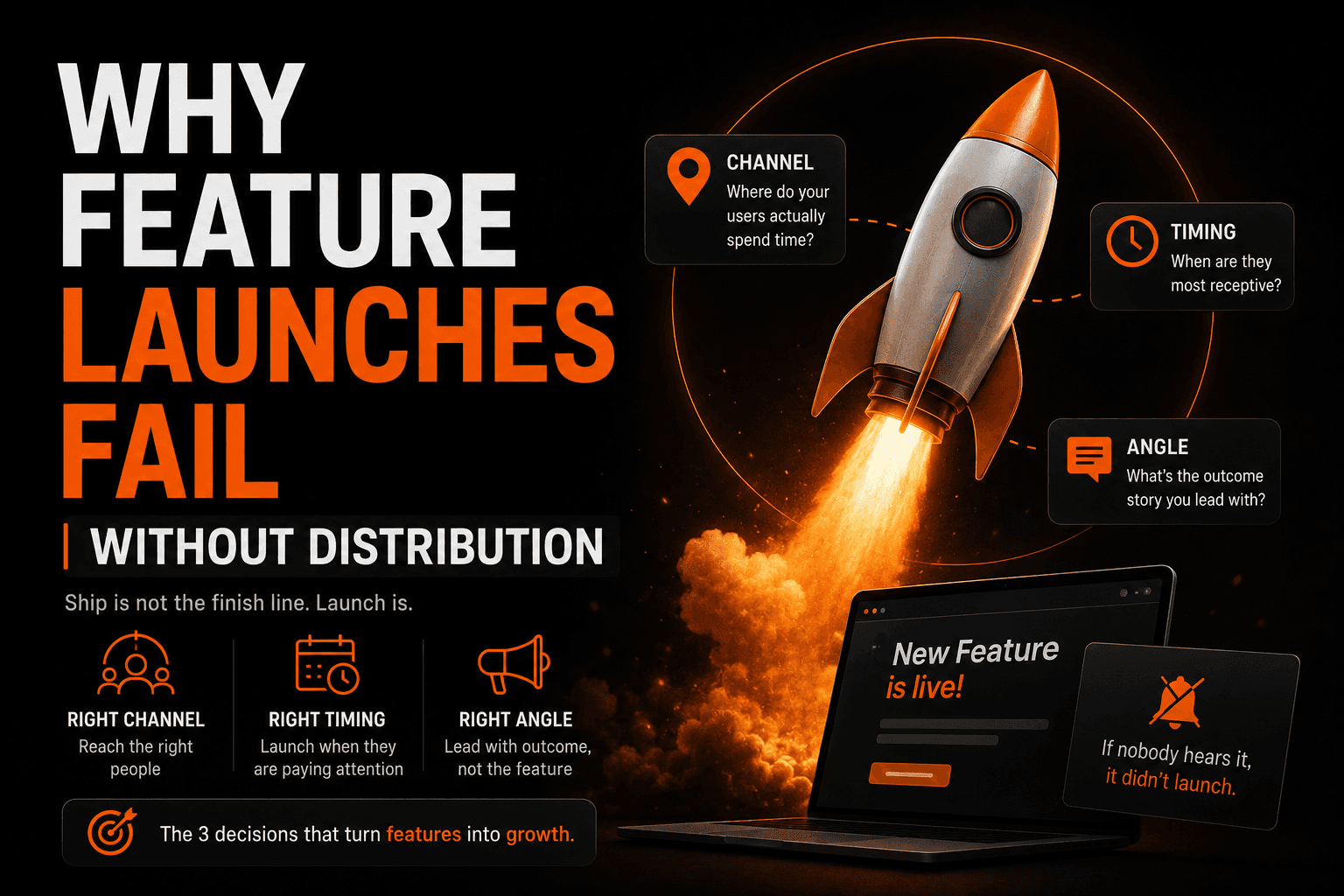
You're Losing Users Before They Ever See Your Product
You spent six weeks building it. The engineering was solid. The team was proud of it.
On release day, someone posted the changelog, someone tweeted "excited to share this," and then nothing happened. A few existing users acknowledged it. Nobody new showed up. The feature you spent six weeks building generated three days of internal excitement and disappeared.
This is not a product problem. It is a distribution problem, and it started long before launch day.
This post breaks down the three most common feature launch mistakes, the framework that fixes them, and how to build distribution into your process before a single line of code gets written.
The difference between shipping and launching
Most product teams treat "it's live" as the finish line. It is the starting line.
Shipping means the feature works and users can access it. Launching means the right people know it exists, understand why they should care, and have a reason to act on it today.
The gap between those two things is where most feature launches die.
A feature launch strategy is not a marketing checklist you run after the build. It is a set of decisions about channel, timing, and angle that should be made before development starts. Teams that make those decisions early get consistent traction from releases. Teams that make them on the Thursday before launch do not.
Why the changelog is not a launch channel
The first instinct of most product teams is to post the changelog, send an in-app notification, and tweet about it. Then wait.
The problem: the changelog reaches users who are already in your product. It does nothing for the people who have never heard of you. It does nothing for the communities where your future users spend time. It does nothing to shape how people talk about the feature when they encounter it later.
A changelog entry is a record. A launch is an event. The teams consistently mistaking one for the other are the same teams whose feature launches generate internal Slack celebration and nothing else.
The 3 failure modes killing feature launches
Failure mode 1: No channel match
The feature is real. The announcement lands where your users are not looking.
A developer tool announced only on LinkedIn. A B2B workflow feature buried in a newsletter the relevant segment stopped reading. A design tool launched to a Twitter following of marketers who will never use it.
Channel selection is a research question, not a preference question. Before any launch, map where the specific segment who will get the most value from this feature actually spends time. Not your whole user base. The segment for whom this feature changes something meaningful. Go where they are, not where you are comfortable.
Failure mode 2: No timing
The launch drops on a random Tuesday with no warm-up and no primed audience.
The best launches do not happen on a schedule. They happen when the target audience is already paying attention to something adjacent, and the launch gives them a reason to care about the next step.
Timing is a research decision. You need to know what is happening in your user's world before you pick a release date. Is there a relevant industry event? A shift in the category? A moment when the problem your feature solves is visibly in the conversation? If yes, ship into that moment. If the answer is "nothing specific," create the moment through pre-launch seeding before the public release.
Failure mode 3: No angle
"We added X" is a commit message. Nobody shares commit messages.
A launch story answers one question: how does someone's day look different now that this feature exists? The feature is the mechanism. The story is the outcome.
Consider this example. A team ships a bulk export feature. They can announce it two ways:
Announcement A: "We've added bulk export to the dashboard."
Announcement B: "Your team was spending 90 minutes every Friday pulling individual reports. Now it takes four clicks."
Same feature. Announcement B is the one that gets forwarded in Slack channels, shared in community groups, and remembered when someone is evaluating your product versus a competitor.
The outcome-first angle is not a copywriting trick. It is the honest answer to what users actually care about.
The feature launch framework: channel, timing, angle
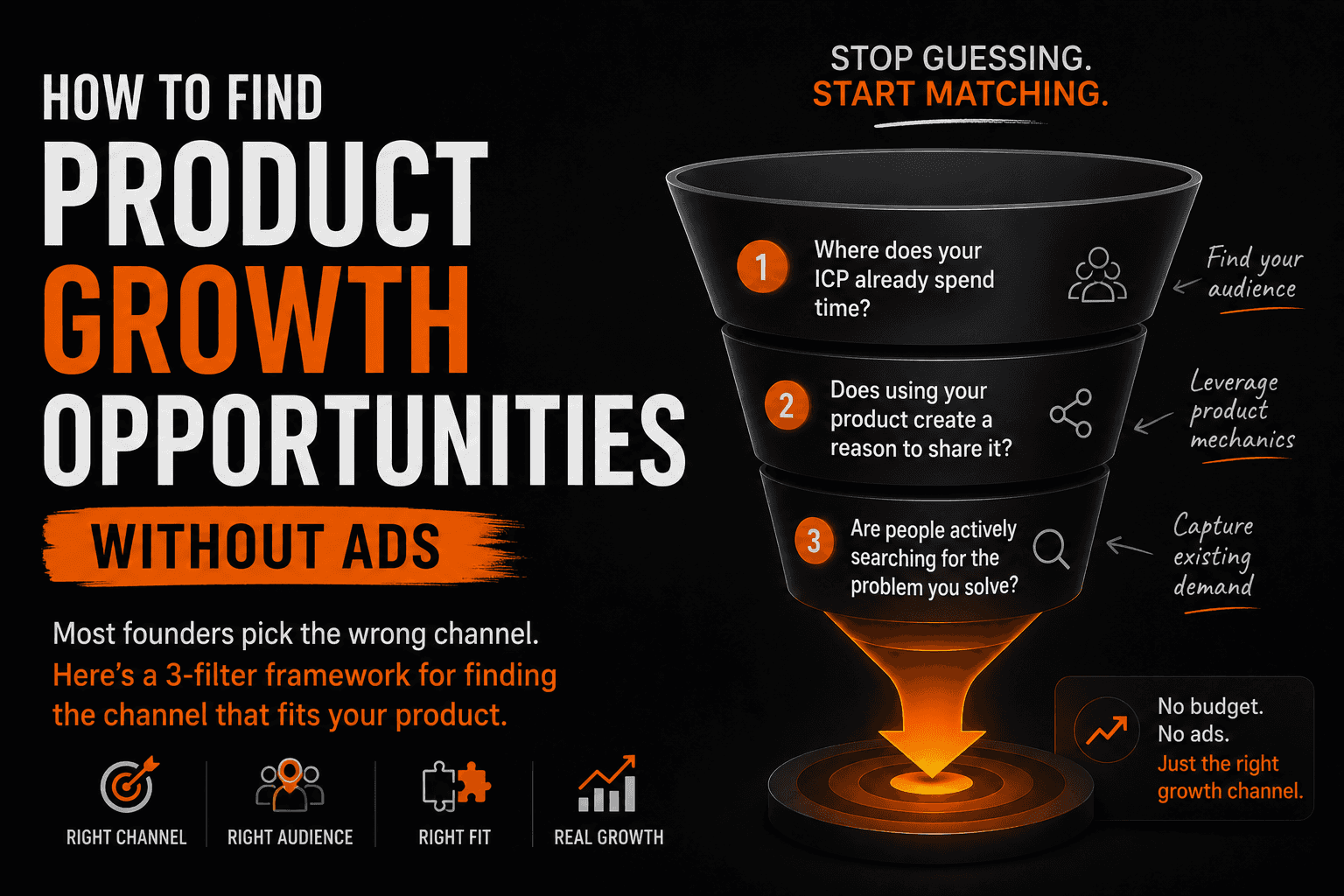
Before every feature launch, answer these three questions. If you cannot answer all three, you are not ready to launch.
1. Channel: where do the people who need this actually spend time?
List the specific communities, platforms, or publications where your target segment is active. Narrow it to the two or three with the highest concentration. Plan how you will show up there specifically for this launch, not generically.
2. Timing: when are they most receptive, and what makes now the right moment?
Identify what is happening in your users' world. What problem are they actively wrestling with? What conversation is already happening in the communities you identified? Pick a launch date and a pre-launch seeding window that puts your feature into an already-active conversation.
3. Angle: what is the outcome story for the person who uses this feature?
Write one sentence that completes this: "Before this feature, [user] had to [problem]. Now they can [outcome] in [timeframe or step count]." That sentence is your launch angle. Every piece of launch communication should connect back to it.
Teams that answer all three before development ends consistently outperform teams that answer none of them. The difference is not product quality. It is distribution discipline.
When to build the launch plan
The right time to start the launch plan is when the feature gets added to the roadmap.
By the time a feature ships, the launch plan should have a draft channel, a draft timing hypothesis, and a draft angle. All three will change as you build and learn. That is expected. Having a draft forces the distribution conversation into the product process rather than treating it as a post-ship marketing problem.
The practical way to do this is to add three fields to every feature brief:
Target segment for this launch (specific, not "all users")
Distribution channel hypothesis (where will we reach them)
Outcome angle (how does this change their day)
These fields do not need to be final. They need to exist. The act of filling them in surfaces distribution problems early, when you can still make product decisions that make the launch story easier to tell.
What this looks like in practice
At Web-to-Figma, scaling to 50K users in six months required treating every growth moment as a distribution problem before a product problem. The question was never just "what should we build next." It was "who needs this, where are they, and what do we need to say to make them act."
That sequencing changes how product decisions get made. Features get scoped differently when the launch story has to be clear from day one.
For AllToolsDirectory, 12K monthly visitors built entirely without paid ads came from the same discipline: matching content to the specific channels where people were already searching for that information, at the moment they needed it.
Distribution is not something you figure out after building. It is a constraint that shapes what you build.
Frequently Asked Questions (FAQs)
Q.1 What is a feature launch strategy?
A feature launch strategy is a plan that defines which channel you will use to reach your target users, when you will launch to maximize receptivity, and what outcome story you will lead with to make the feature meaningful to the people who need it. It is built before development ends, not after the feature ships.
Q.2 Why do most SaaS feature launches fail?
Most SaaS feature launches fail because teams treat distribution as a post-ship checklist instead of a product decision. The three most common failure modes are channel mismatch (announcing in the wrong place), bad timing (no warm-up, no adjacent moment), and no angle (leading with the feature capability instead of the user outcome).
Q.3 When should you start planning a feature launch?
Start when the feature enters the roadmap. A draft channel hypothesis, timing hypothesis, and outcome angle should exist before development begins. These will change as the feature gets built, but starting early prevents distribution from becoming a last-minute problem.
Q.4 What makes a good feature launch angle?
A good launch angle leads with user outcome, not product capability. It completes the sentence: "Before this feature, [user] had to [problem]. Now they can [outcome] in [timeframe]." This framing is shareable, memorable, and gives users a reason to tell others about it.
Q.5 How do you choose the right launch channel for a feature?
Identify the specific user segment who gets the most value from this feature. Map where that segment actually spends time: which communities, publications, platforms, or events. Pick the channel with the highest concentration of that segment, not the channel where you have the most followers.
You spent six weeks building it. The engineering was solid. The team was proud of it.
On release day, someone posted the changelog, someone tweeted "excited to share this," and then nothing happened. A few existing users acknowledged it. Nobody new showed up. The feature you spent six weeks building generated three days of internal excitement and disappeared.
This is not a product problem. It is a distribution problem, and it started long before launch day.
This post breaks down the three most common feature launch mistakes, the framework that fixes them, and how to build distribution into your process before a single line of code gets written.
The difference between shipping and launching
Most product teams treat "it's live" as the finish line. It is the starting line.
Shipping means the feature works and users can access it. Launching means the right people know it exists, understand why they should care, and have a reason to act on it today.
The gap between those two things is where most feature launches die.
A feature launch strategy is not a marketing checklist you run after the build. It is a set of decisions about channel, timing, and angle that should be made before development starts. Teams that make those decisions early get consistent traction from releases. Teams that make them on the Thursday before launch do not.
Why the changelog is not a launch channel
The first instinct of most product teams is to post the changelog, send an in-app notification, and tweet about it. Then wait.
The problem: the changelog reaches users who are already in your product. It does nothing for the people who have never heard of you. It does nothing for the communities where your future users spend time. It does nothing to shape how people talk about the feature when they encounter it later.
A changelog entry is a record. A launch is an event. The teams consistently mistaking one for the other are the same teams whose feature launches generate internal Slack celebration and nothing else.
The 3 failure modes killing feature launches
Failure mode 1: No channel match
The feature is real. The announcement lands where your users are not looking.
A developer tool announced only on LinkedIn. A B2B workflow feature buried in a newsletter the relevant segment stopped reading. A design tool launched to a Twitter following of marketers who will never use it.
Channel selection is a research question, not a preference question. Before any launch, map where the specific segment who will get the most value from this feature actually spends time. Not your whole user base. The segment for whom this feature changes something meaningful. Go where they are, not where you are comfortable.
Failure mode 2: No timing
The launch drops on a random Tuesday with no warm-up and no primed audience.
The best launches do not happen on a schedule. They happen when the target audience is already paying attention to something adjacent, and the launch gives them a reason to care about the next step.
Timing is a research decision. You need to know what is happening in your user's world before you pick a release date. Is there a relevant industry event? A shift in the category? A moment when the problem your feature solves is visibly in the conversation? If yes, ship into that moment. If the answer is "nothing specific," create the moment through pre-launch seeding before the public release.
Failure mode 3: No angle
"We added X" is a commit message. Nobody shares commit messages.
A launch story answers one question: how does someone's day look different now that this feature exists? The feature is the mechanism. The story is the outcome.
Consider this example. A team ships a bulk export feature. They can announce it two ways:
Announcement A: "We've added bulk export to the dashboard."
Announcement B: "Your team was spending 90 minutes every Friday pulling individual reports. Now it takes four clicks."
Same feature. Announcement B is the one that gets forwarded in Slack channels, shared in community groups, and remembered when someone is evaluating your product versus a competitor.
The outcome-first angle is not a copywriting trick. It is the honest answer to what users actually care about.
The feature launch framework: channel, timing, angle
Before every feature launch, answer these three questions. If you cannot answer all three, you are not ready to launch.
1. Channel: where do the people who need this actually spend time?
List the specific communities, platforms, or publications where your target segment is active. Narrow it to the two or three with the highest concentration. Plan how you will show up there specifically for this launch, not generically.
2. Timing: when are they most receptive, and what makes now the right moment?
Identify what is happening in your users' world. What problem are they actively wrestling with? What conversation is already happening in the communities you identified? Pick a launch date and a pre-launch seeding window that puts your feature into an already-active conversation.
3. Angle: what is the outcome story for the person who uses this feature?
Write one sentence that completes this: "Before this feature, [user] had to [problem]. Now they can [outcome] in [timeframe or step count]." That sentence is your launch angle. Every piece of launch communication should connect back to it.
Teams that answer all three before development ends consistently outperform teams that answer none of them. The difference is not product quality. It is distribution discipline.
When to build the launch plan
The right time to start the launch plan is when the feature gets added to the roadmap.
By the time a feature ships, the launch plan should have a draft channel, a draft timing hypothesis, and a draft angle. All three will change as you build and learn. That is expected. Having a draft forces the distribution conversation into the product process rather than treating it as a post-ship marketing problem.
The practical way to do this is to add three fields to every feature brief:
Target segment for this launch (specific, not "all users")
Distribution channel hypothesis (where will we reach them)
Outcome angle (how does this change their day)
These fields do not need to be final. They need to exist. The act of filling them in surfaces distribution problems early, when you can still make product decisions that make the launch story easier to tell.
What this looks like in practice
At Web-to-Figma, scaling to 50K users in six months required treating every growth moment as a distribution problem before a product problem. The question was never just "what should we build next." It was "who needs this, where are they, and what do we need to say to make them act."
That sequencing changes how product decisions get made. Features get scoped differently when the launch story has to be clear from day one.
For AllToolsDirectory, 12K monthly visitors built entirely without paid ads came from the same discipline: matching content to the specific channels where people were already searching for that information, at the moment they needed it.
Distribution is not something you figure out after building. It is a constraint that shapes what you build.
Frequently Asked Questions (FAQs)
Q.1 What is a feature launch strategy?
A feature launch strategy is a plan that defines which channel you will use to reach your target users, when you will launch to maximize receptivity, and what outcome story you will lead with to make the feature meaningful to the people who need it. It is built before development ends, not after the feature ships.
Q.2 Why do most SaaS feature launches fail?
Most SaaS feature launches fail because teams treat distribution as a post-ship checklist instead of a product decision. The three most common failure modes are channel mismatch (announcing in the wrong place), bad timing (no warm-up, no adjacent moment), and no angle (leading with the feature capability instead of the user outcome).
Q.3 When should you start planning a feature launch?
Start when the feature enters the roadmap. A draft channel hypothesis, timing hypothesis, and outcome angle should exist before development begins. These will change as the feature gets built, but starting early prevents distribution from becoming a last-minute problem.
Q.4 What makes a good feature launch angle?
A good launch angle leads with user outcome, not product capability. It completes the sentence: "Before this feature, [user] had to [problem]. Now they can [outcome] in [timeframe]." This framing is shareable, memorable, and gives users a reason to tell others about it.
Q.5 How do you choose the right launch channel for a feature?
Identify the specific user segment who gets the most value from this feature. Map where that segment actually spends time: which communities, publications, platforms, or events. Pick the channel with the highest concentration of that segment, not the channel where you have the most followers.
Blogs By Prateek
Real frameworks, honest breakdowns, and hard-won lessons from 6 years of launching and growing AI products.
LET'S WORK
TOGETHER
LET'S WORK
TOGETHER
@2026, All Rights Reserved