






Available For Work


How Great Brands Position Themselves (And Where Most Go Wrong)
Most companies do not have a product problem. They have a positioning problem they keep mistaking for a product problem.
They add features. Redesign the homepage. Run more ads. Numbers stay flat. The team gets frustrated. Someone suggests a rebrand. None of it works because none of it addresses the actual issue.
Positioning is the most expensive thing most teams never put a budget line against. And by the time they realise it is broken, they have already paid for it in churn, in low conversion, and in a sales team that cannot explain what they are selling.
Here is what bad positioning actually costs, what kills it, and what the brands that got it right did differently.
What Positioning Actually Is
Positioning is not your tagline. Not your color palette. Not the adjectives on your about page. It is the answer to one question your buyer asks in the first 8 seconds of seeing your product:
"Is this built for someone like me?"
If that answer is not immediate and obvious, you have already lost them. Not because your product is bad. Because your positioning did not do its job.
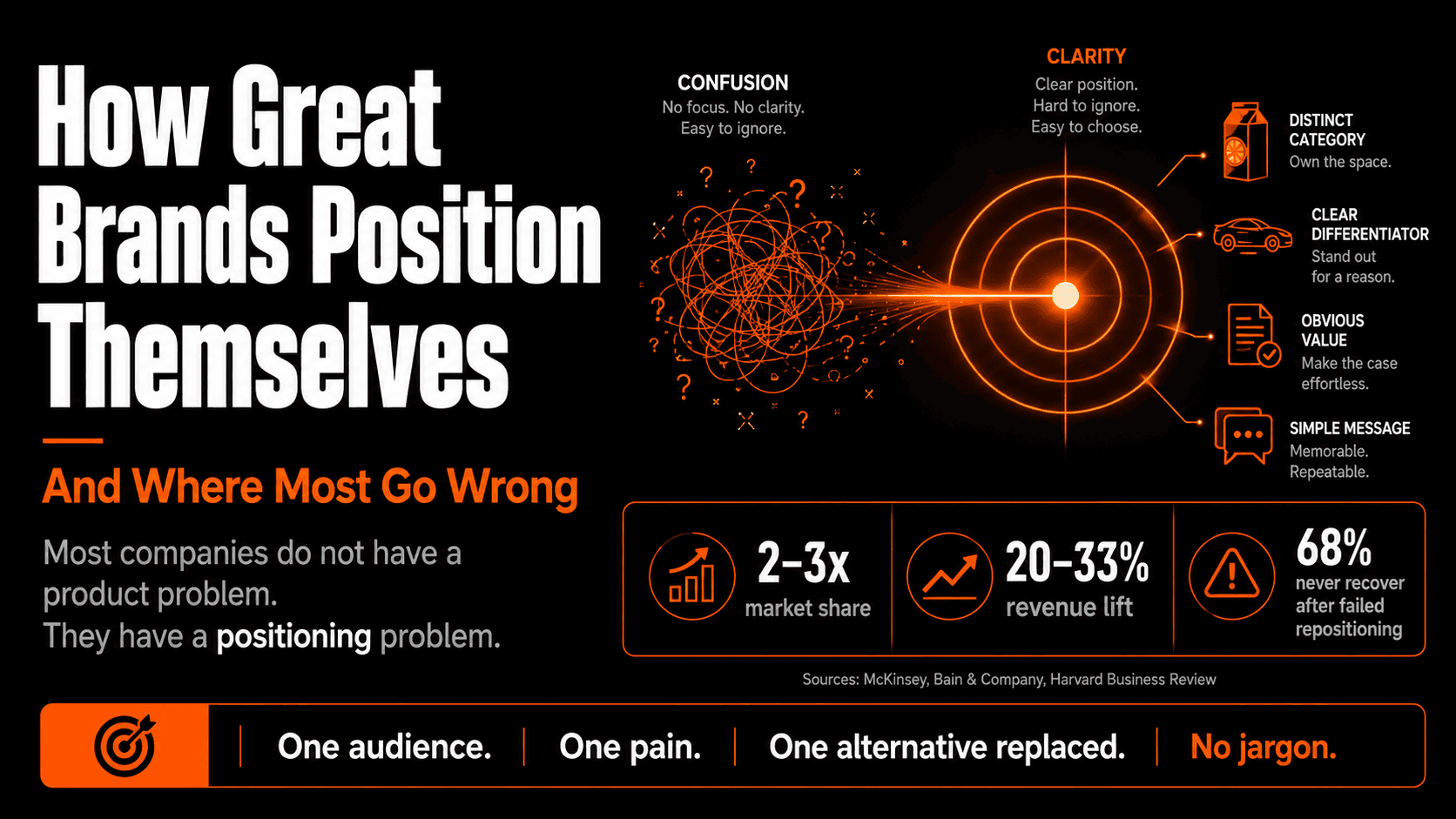
The numbers make this hard to ignore. Companies with clear brand positioning see a 2 to 3x increase in market share. Consistent messaging alone increases revenue by 20 to 33%. And a failed repositioning can wipe out 20 to 40% of your customer base, with 68% of those brands never recovering their original market position.
Those are not brand metrics. Those are business survival metrics.
What Bad Positioning Looks Like
The dangerous thing about bad positioning is that it does not announce itself. The product still works. The team is still shipping. The marketing is still running. But conversion is slow, churn is high, and nobody can explain exactly why.
Here are three brands that found out the hard way.
Tropicana: When the signal disappears
In 2009, Tropicana decided their packaging needed a modern refresh. They removed the iconic orange-with-a-straw imagery and replaced it with a clean glass of juice on a white background.
They did not touch the product. Not a single ingredient changed.
Sales dropped 20% in two months. $130 million in revenue disappeared before they reversed the decision.
What went wrong? The packaging was not decoration. It was the entire positioning signal. That orange and straw told customers in under a second: this is the premium one, the trusted one, the one you always buy. When the visual signal disappeared, so did the certainty. Shoppers picked something else without even thinking about it.
Jaguar: Repositioning without a bridge
In November 2024, Jaguar deleted their entire social media history and released a rebrand video featuring high-fashion models and zero cars. New slogans: "copy nothing" and "delete ordinary."
Elon Musk asked publicly: "Do you sell cars?"
That single question captured the entire failure. Jaguar stood for British performance and craftsmanship. Their buyers had a clear, emotionally anchored belief about what the brand meant. The rebrand abandoned that belief entirely with no explanation, no transition, no bridge between what buyers knew and what they were now being asked to believe.
You can reposition a brand. But you cannot erase what buyers already believe and expect them to follow you somewhere new with no context. That is not bold reinvention. That is abandonment dressed up as strategy.
Docusign: Inventing a category nobody asked for
In 2024, Docusign launched a new positioning around a category they called "Intelligent Agreement Management."
Nobody searched for that term. Nobody used those words in a sales call. No customer had ever said "what I really need is intelligent agreement management."
The category existed entirely inside their boardroom. They walked it back within months.
Inventing a new category can work. Salesforce did it with "CRM in the cloud." HubSpot did it with "inbound marketing." But both of those categories described problem buyers were already experiencing without language for it. "Intelligent Agreement Management" described a product capability. That is the difference between a category that creates a market and one that becomes a cautionary slide deck.
What Kills Positioning Every Time
Across every failed positioning story, the same patterns appear. Recognising them is half the work.
Trying to speak to everyone. The moment your positioning tries to stay relevant to all buyer types, it becomes memorable to none. Sharp positioning always excludes someone. That is not a flaw. That is the mechanism.
Writing for the product, not the buyer. Features describe what the product does. Positioning describes what the buyer no longer has to live with. Those are completely different sentences.
Changing the name without changing the experience. RadioShack rebranded as "The Shack" in 2009 to appeal to younger buyers. The stores, products, and experience stayed identical. The new name did not solve an identity problem. It made the identity crisis more visible. Bankruptcy followed.
Inventing categories nobody asked for. If your buyers cannot connect the category name to a pain they already feel, the category will not stick. You will spend money educating the market on a problem they do not recognise, which is the most expensive marketing you can do.
Repositioning with no bridge. When you ask buyers to update their mental model of your brand, you have to walk them there. You cannot delete where they are and expect them to teleport to where you want them to be.
What Good Positioning Looks Like
The brands that get positioning right are not always the ones with the biggest budgets. They are the ones who made a clear decision about who they exist for and refused to blur that line.
Zoho: The philosophy is the positioning
Zoho is one of the most underanalysed positioning stories in SaaS, largely because Western marketing content rarely covers it.
The setup: Salesforce dominates enterprise CRM. Microsoft dominates productivity. Any rational analysis says there is no room for a bootstrapped software company from rural Tamil Nadu to compete at scale across both.
Zoho did not agree.
Their positioning was never "better software." It was one contrarian bet held for 29 years: enterprise-grade software without enterprise-grade pricing, investor pressure, or Silicon Valley overhead. No VC funding. No advertising spends. No quarterly earnings pressure.
The result: Rs 12,000 crore in revenue. 100 million users across 150 countries. Complete ownership. Zero traditional ad spend.
The philosophy became the positioning. The positioning became the moat. And because no VC-backed competitor can credibly claim the same thing, the moat compounds every year.
Zepto: Own one number
Zepto did not build a grocery app. They built a "10 minutes or nothing" brand.
Before Zepto, 30 minutes was considered fast in Indian quick commerce. They did not compete on product range, app design, or pricing. They picked one number, built their entire operation around it, and made that number the brand identity.
By late 2024, Zepto held 29% of the Indian quick commerce market despite not being the first mover and not having the Zomato ecosystem behind them. They achieved this through one positioning decision made early and held consistently.
When your brand owns a specific, measurable promise that represents a real buyer desire, you do not need to explain much else.
Loom: Replace a behaviour, not a product
Loom's positioning is one of the cleanest examples of competitive framing done right.
They did not position against screen recorders. They positioned against meetings.
"Say it with a video" is not a feature description. It is a behaviour replacement. It tells you who this is for, what pain it removes, and what it replaces in one sentence. The alternative is not a competing tool. The alternative is a calendar invite.
That one reframe changed their target audience, their pricing logic, and their entire go-to-market motion. They were not selling software. They were selling time back.
The Formula Behind Every Brand That Gets It Right
Strip away the brand names and industries. Every sharp positioning story follows the same structure:
One audience. One pain. One alternative replaced. No jargon.
Not a platform for everyone. Not "AI-powered solutions for modern teams." One person with one problem they are tired of having, and one thing your product replaces in their workflow or life.
Run this test on your own product right now. Show your homepage to someone who has never seen it. After 8 seconds, ask three questions:
Who is this for?
What problem does it solve?
Why this and not something else?
If they hesitate on any of the three, you do not have a messaging problem. You have a positioning problem. And no amount of copy tweaks, ad spend, or feature releases will fix it until the positioning underneath is clear.
The Real Cost of Getting This Wrong
Bad positioning is not a marketing budget problem. It is a compounding business problem.
It attracts the wrong users, which drives up churn. It confuses the right users, which kills conversion. It creates internal misalignment because sales, product, and marketing are all working from a different version of what the product is and who it is for.
Tropicana lost $130 million fixing a positioning signal they did not know they had until they removed it. Jaguar spent months managing reputation damage from a rebrand that alienated its most loyal buyers. Docusign invested in a category narrative that had to be quietly retired.
The brands that win are not the ones with the sharpest taglines. They are the ones who made a clear decision about who they exist for and held that line consistently.
Positioning is not a launch activity. It is not a marketing team's quarterly project. It is a discipline that either compounds in your favour or quietly erodes everything else you are building.
If this was useful, subscribe below. Every issue breaks down product marketing, GTM strategy, and growth decisions grounded in real products and real numbers. No borrowed frameworks. No theory without proof.
Most companies do not have a product problem. They have a positioning problem they keep mistaking for a product problem.
They add features. Redesign the homepage. Run more ads. Numbers stay flat. The team gets frustrated. Someone suggests a rebrand. None of it works because none of it addresses the actual issue.
Positioning is the most expensive thing most teams never put a budget line against. And by the time they realise it is broken, they have already paid for it in churn, in low conversion, and in a sales team that cannot explain what they are selling.
Here is what bad positioning actually costs, what kills it, and what the brands that got it right did differently.
What Positioning Actually Is
Positioning is not your tagline. Not your color palette. Not the adjectives on your about page. It is the answer to one question your buyer asks in the first 8 seconds of seeing your product:
"Is this built for someone like me?"
If that answer is not immediate and obvious, you have already lost them. Not because your product is bad. Because your positioning did not do its job.
The numbers make this hard to ignore. Companies with clear brand positioning see a 2 to 3x increase in market share. Consistent messaging alone increases revenue by 20 to 33%. And a failed repositioning can wipe out 20 to 40% of your customer base, with 68% of those brands never recovering their original market position.
Those are not brand metrics. Those are business survival metrics.
What Bad Positioning Looks Like
The dangerous thing about bad positioning is that it does not announce itself. The product still works. The team is still shipping. The marketing is still running. But conversion is slow, churn is high, and nobody can explain exactly why.
Here are three brands that found out the hard way.
Tropicana: When the signal disappears
In 2009, Tropicana decided their packaging needed a modern refresh. They removed the iconic orange-with-a-straw imagery and replaced it with a clean glass of juice on a white background.
They did not touch the product. Not a single ingredient changed.
Sales dropped 20% in two months. $130 million in revenue disappeared before they reversed the decision.
What went wrong? The packaging was not decoration. It was the entire positioning signal. That orange and straw told customers in under a second: this is the premium one, the trusted one, the one you always buy. When the visual signal disappeared, so did the certainty. Shoppers picked something else without even thinking about it.
Jaguar: Repositioning without a bridge
In November 2024, Jaguar deleted their entire social media history and released a rebrand video featuring high-fashion models and zero cars. New slogans: "copy nothing" and "delete ordinary."
Elon Musk asked publicly: "Do you sell cars?"
That single question captured the entire failure. Jaguar stood for British performance and craftsmanship. Their buyers had a clear, emotionally anchored belief about what the brand meant. The rebrand abandoned that belief entirely with no explanation, no transition, no bridge between what buyers knew and what they were now being asked to believe.
You can reposition a brand. But you cannot erase what buyers already believe and expect them to follow you somewhere new with no context. That is not bold reinvention. That is abandonment dressed up as strategy.
Docusign: Inventing a category nobody asked for
In 2024, Docusign launched a new positioning around a category they called "Intelligent Agreement Management."
Nobody searched for that term. Nobody used those words in a sales call. No customer had ever said "what I really need is intelligent agreement management."
The category existed entirely inside their boardroom. They walked it back within months.
Inventing a new category can work. Salesforce did it with "CRM in the cloud." HubSpot did it with "inbound marketing." But both of those categories described problem buyers were already experiencing without language for it. "Intelligent Agreement Management" described a product capability. That is the difference between a category that creates a market and one that becomes a cautionary slide deck.
What Kills Positioning Every Time
Across every failed positioning story, the same patterns appear. Recognising them is half the work.
Trying to speak to everyone. The moment your positioning tries to stay relevant to all buyer types, it becomes memorable to none. Sharp positioning always excludes someone. That is not a flaw. That is the mechanism.
Writing for the product, not the buyer. Features describe what the product does. Positioning describes what the buyer no longer has to live with. Those are completely different sentences.
Changing the name without changing the experience. RadioShack rebranded as "The Shack" in 2009 to appeal to younger buyers. The stores, products, and experience stayed identical. The new name did not solve an identity problem. It made the identity crisis more visible. Bankruptcy followed.
Inventing categories nobody asked for. If your buyers cannot connect the category name to a pain they already feel, the category will not stick. You will spend money educating the market on a problem they do not recognise, which is the most expensive marketing you can do.
Repositioning with no bridge. When you ask buyers to update their mental model of your brand, you have to walk them there. You cannot delete where they are and expect them to teleport to where you want them to be.
What Good Positioning Looks Like
The brands that get positioning right are not always the ones with the biggest budgets. They are the ones who made a clear decision about who they exist for and refused to blur that line.
Zoho: The philosophy is the positioning
Zoho is one of the most underanalysed positioning stories in SaaS, largely because Western marketing content rarely covers it.
The setup: Salesforce dominates enterprise CRM. Microsoft dominates productivity. Any rational analysis says there is no room for a bootstrapped software company from rural Tamil Nadu to compete at scale across both.
Zoho did not agree.
Their positioning was never "better software." It was one contrarian bet held for 29 years: enterprise-grade software without enterprise-grade pricing, investor pressure, or Silicon Valley overhead. No VC funding. No advertising spends. No quarterly earnings pressure.
The result: Rs 12,000 crore in revenue. 100 million users across 150 countries. Complete ownership. Zero traditional ad spend.
The philosophy became the positioning. The positioning became the moat. And because no VC-backed competitor can credibly claim the same thing, the moat compounds every year.
Zepto: Own one number
Zepto did not build a grocery app. They built a "10 minutes or nothing" brand.
Before Zepto, 30 minutes was considered fast in Indian quick commerce. They did not compete on product range, app design, or pricing. They picked one number, built their entire operation around it, and made that number the brand identity.
By late 2024, Zepto held 29% of the Indian quick commerce market despite not being the first mover and not having the Zomato ecosystem behind them. They achieved this through one positioning decision made early and held consistently.
When your brand owns a specific, measurable promise that represents a real buyer desire, you do not need to explain much else.
Loom: Replace a behaviour, not a product
Loom's positioning is one of the cleanest examples of competitive framing done right.
They did not position against screen recorders. They positioned against meetings.
"Say it with a video" is not a feature description. It is a behaviour replacement. It tells you who this is for, what pain it removes, and what it replaces in one sentence. The alternative is not a competing tool. The alternative is a calendar invite.
That one reframe changed their target audience, their pricing logic, and their entire go-to-market motion. They were not selling software. They were selling time back.
The Formula Behind Every Brand That Gets It Right
Strip away the brand names and industries. Every sharp positioning story follows the same structure:
One audience. One pain. One alternative replaced. No jargon.
Not a platform for everyone. Not "AI-powered solutions for modern teams." One person with one problem they are tired of having, and one thing your product replaces in their workflow or life.
Run this test on your own product right now. Show your homepage to someone who has never seen it. After 8 seconds, ask three questions:
Who is this for?
What problem does it solve?
Why this and not something else?
If they hesitate on any of the three, you do not have a messaging problem. You have a positioning problem. And no amount of copy tweaks, ad spend, or feature releases will fix it until the positioning underneath is clear.
The Real Cost of Getting This Wrong
Bad positioning is not a marketing budget problem. It is a compounding business problem.
It attracts the wrong users, which drives up churn. It confuses the right users, which kills conversion. It creates internal misalignment because sales, product, and marketing are all working from a different version of what the product is and who it is for.
Tropicana lost $130 million fixing a positioning signal they did not know they had until they removed it. Jaguar spent months managing reputation damage from a rebrand that alienated its most loyal buyers. Docusign invested in a category narrative that had to be quietly retired.
The brands that win are not the ones with the sharpest taglines. They are the ones who made a clear decision about who they exist for and held that line consistently.
Positioning is not a launch activity. It is not a marketing team's quarterly project. It is a discipline that either compounds in your favour or quietly erodes everything else you are building.
If this was useful, subscribe below. Every issue breaks down product marketing, GTM strategy, and growth decisions grounded in real products and real numbers. No borrowed frameworks. No theory without proof.
Blogs By Prateek
Real frameworks, honest breakdowns, and hard-won lessons from 6 years of launching and growing AI products.

LET'S WORK
TOGETHER
LET'S WORK
TOGETHER
@2026, All Rights Reserved