






Available For Work


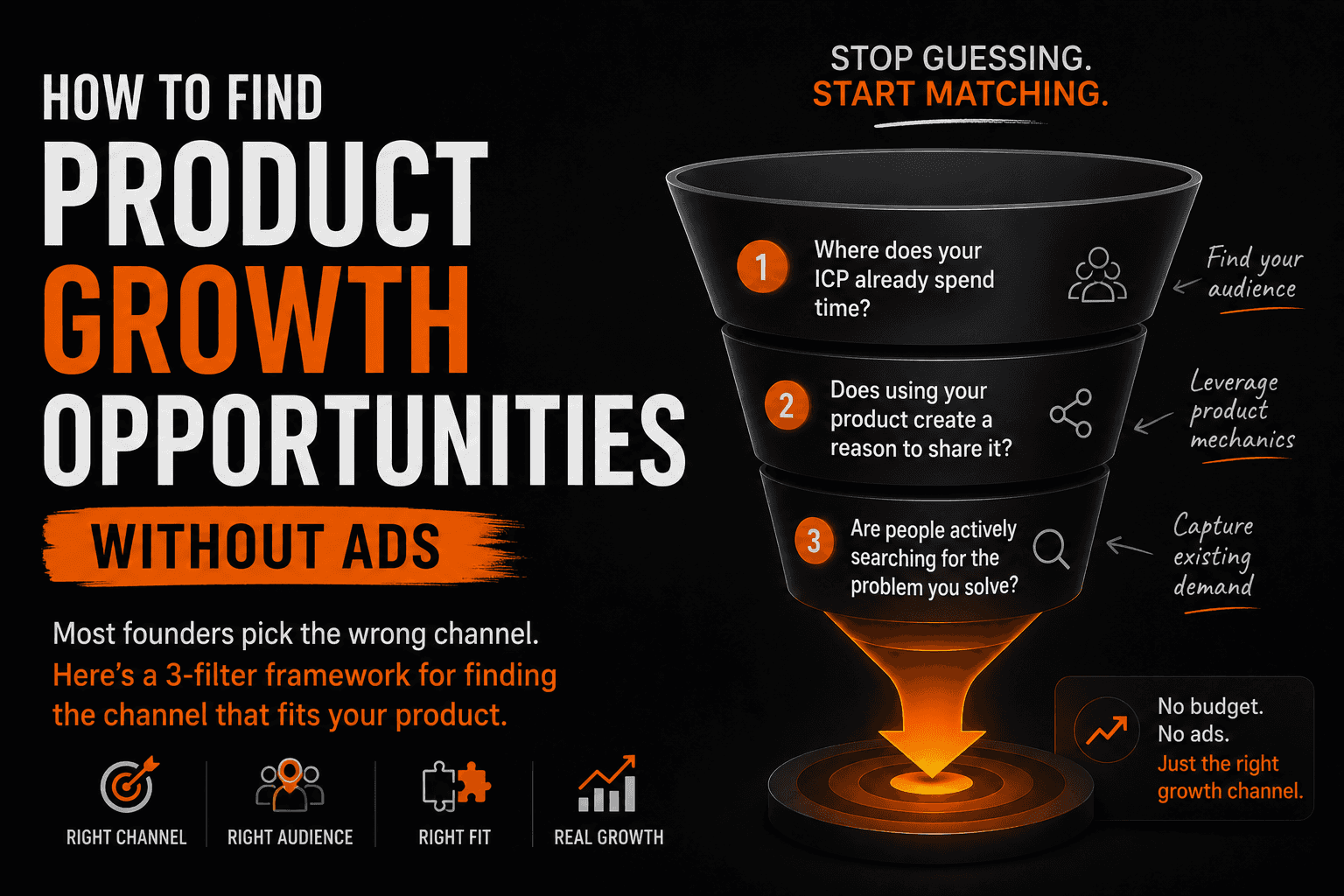
How to Find Product Growth Opportunities Without Ads
AllToolsDirectory gets 12,000 monthly visitors. No paid ads. No agency. No outreach. Web-to-Figma reached 50,000 users in six months. Same story.
Neither result came from picking the right tactic. Both came from picking the right channel for what the product actually was. That distinction separates founders who find traction from founders who run three months of experiments and conclude that organic growth is a myth.
Most founders skip this step. They pick channels based on what's trending in growth newsletters, or based on what worked for a different founder building a different product for a different audience. Then they spend 90 days testing something that was never going to work for their specific case.
This post gives you a 3-filter framework for finding product growth opportunities without ads, and for picking the one channel to start with before you run a single experiment.
Why the Channel List Is Not Your Problem
Search "zero budget growth channels" and you get the same list every time: SEO, communities, Product Hunt, cold outreach, content marketing, PLG, referrals, partnerships.
The list is accurate. It is also useless without a filter.
A founder building a B2B data tool and a founder building a Figma plugin are not running the same playbook. The channels that compound for one will stall for the other, not because the channels are bad, but because the match is wrong.
The channel does not create growth. The match between channel and product does.
Before you run any zero-budget growth experiment, you need a filter that tells you which channel fits your product. That filter is three questions.
The 3-Filter Framework for Finding Product Growth Opportunities
Filter 1: Where Does Your ICP Already Spend Time?
Not where you think they should be. Where they actually are right now, before they know your product exists.
This question sounds obvious. Most founders answer it vaguely. "They're on LinkedIn." "They're on Twitter." Those answers are too broad to be useful.
The specific version: which subreddit, which Slack community, which platform, which weekly newsletter, which conference, which Figma Community page does your ICP visit because they want to, not because someone told them to?
Web-to-Figma answered this precisely. The ICP was designers who lived inside Figma every workday. They visited the Figma Community to find plugins, resources, and workflow tools. That community was already aggregating the exact people the product needed. The channel choice was not clever. It was the obvious conclusion of asking the question with specificity.
If your answer to this filter is a named, specific community, that is your first channel. Show up there as a contributor. The 80/20 rule applies: 80% of your presence helps others, 20% can mention your product, and only when the context makes it genuinely relevant. Build four weeks of presence before you mention anything.
Filter 2: Does Using Your Product Create a Natural Reason to Share It?
Some products have a share trigger built into the core action. A user creates something, sends something, or publishes something, and the output reaches people who have never heard of your product.
Figma is the textbook example. Every shared file was a distribution channel. The person receiving the file did not need a sales pitch. They opened the file, saw what was possible, and wanted access. The product spread through the act of being used.
If your product has this mechanic, product-led growth is your first channel. Before anything else, audit the sharing moment: how many steps does it take for a user to share an output from your product? How easy is it for the recipient to sign up after receiving that output? What percentage of your current users have generated at least one share?
That last number is your starting K-factor. If it is above 0.3, you have a loop worth investing in. If it is below 0.1, the sharing trigger either does not exist or has too much friction. Fix the friction before building any other channel.
If your product has no natural share trigger, do not force one. Move to filter 3.
Filter 3: Are People Actively Searching for the Problem Your Product Solves?
If people are already typing questions into Google that your product answers, SEO is your channel. Not because SEO is good in general, but because the demand already exists and you are leaving it unaddressed.
AllToolsDirectory is a directory of AI tools. People search for "best AI tools for X" every day. The product is the answer to those searches. Building SEO content was not a growth hack. It was pointing existing traffic at something that already had a reason to exist.
The key is specificity in keyword targeting. Ranking for "AI tools" is not realistic for a new domain. Ranking for "best AI writing tools for newsletters" or "free AI image tools for Shopify" is. Long-tail keywords with specific modifiers have lower competition, clearer intent, and higher conversion rates.
A visitor searching "AI image tool for product photography" already knows what they want. They convert at 3 to 5x the rate of someone who arrived from a broad informational query. Start with 10 long-tail keywords. Write one post per keyword. Publish on a consistent schedule for 90 days before measuring outcomes.
How to Use the Three Filters
Run all three questions against your product right now. Write your answers in one sentence each.
If filter 1 has the clearest answer: Start with community. Pick one platform. Spend the first four weeks contributing without mentioning your product. Introduce it in week five when the context fits.
If filter 2 has the clearest answer: Start with PLG. Audit the sharing moment in your product. Remove every step between the core action and the share trigger. Then remove steps from the recipient's path to signup.
If filter 3 has the clearest answer: Start with SEO. Pick 10 long-tail keywords. Map each to a specific post. Write one post per week for 10 weeks.
If all three have clear answers: Pick the one you can execute with the least friction in the next 30 days. Execution speed matters more than picking the theoretically optimal channel.
One channel. 90 days. Then measure.
The Pattern Across Three Products
Web-to-Figma, AllToolsDirectory, and Web-to-MCP each used a different channel. None were chosen because they were trending.
Web-to-Figma used Figma Community because filter 1 pointed there. The ICP lived inside Figma.
AllToolsDirectory used SEO because filter 3 pointed there. People search for tools. The product is a directory. The match was direct.
Web-to-MCP used Product Hunt because filter 1 pointed there. The MCP wave was new in early 2024. Builders were actively looking for tools to try. Product Hunt was where that audience aggregated at that specific moment. Timing, channel, and ICP habitat all matched. The result was a Top 5 finish and a 20% free-to-paid conversion rate.
Three products. Three channels. One consistent logic: the channel matched the product's natural habitat.
The Mistake That Kills Early-Stage Growth
Channel-switching too fast is the most expensive mistake early-stage founders make.
SEO content takes 3 to 6 months to rank. Community trust takes 4 to 6 weeks to earn before you have standing to mention your product. PLG loops take multiple growth cycles to show up in the data.
Founders who switch channels after three weeks never see those results. They conclude organic growth does not work. The channel did not fail. They stopped before compounding started.
The inputs are what you control, not the outputs. If you are publishing consistently, showing up in the community, or watching share rates climb, the channel is working. The traffic numbers take longer to follow.
Commit to 90 days of genuine execution before evaluating. That is the minimum time for any zero-budget channel to show its real signal.
How AI Search Changes the Zero-Budget Growth Equation
One layer on top of this framework worth understanding in 2025: AI search engines now surface content alongside traditional Google results.
ChatGPT, Perplexity, and Google AI Overviews increasingly cite blog posts, guides, and comparison pages when answering product-related queries. A post that ranks on page 2 of Google can still get cited in AI answers if the content is structured clearly and answers a specific question directly.
For zero-budget growth, this matters because it expands the ceiling on SEO. A well-structured post with clear subheadings, specific data points, and first-hand examples gets cited in AI answers and drives traffic that does not show up in traditional rank tracking.
The practical implication: write posts that answer one specific question completely. Use subheadings that mirror the question a searcher would type. Include real numbers from your own products wherever possible. Those are the signals AI systems extract when deciding what to cite.
One Question to Answer Before You Start
Before picking any channel, write this sentence:
"My ICP is [specific person] who currently [specific behavior] on [specific platform] because [specific reason]."
If you cannot complete it with specifics, the channel question is premature. You need sharper ICP clarity before you decide where to find them.
Web-to-Figma: "My ICP is a designer who browses the Figma Community to find plugins that speed up repetitive tasks inside their existing workflow."
That sentence points directly at a channel. It always does.
Get the sentence right. The channel follows.
What to Do This Week
Answer the three filters for your product. Write one sentence per filter.
Pick the filter with the clearest, most specific answer. Build your first 30 days of channel activity around that single answer.
Do not spread across three channels at once. Depth in one channel compounds. Surface-level presence in five channels produces nothing.
If you are building an AI product and want to see how this framework applies to your specific case, I write about zero-budget product growth every week. Subscribe below.
Frequently Asked Questions
How long does zero-budget product growth take to show results?
SEO takes 3 to 6 months for posts to rank. Community channels show results in 4 to 8 weeks if you execute consistently. PLG loops depend on activation rate and share trigger friction, but a well-designed loop compounds within 60 days. Do not measure any channel before 90 days of genuine execution.
Which zero-budget growth channel works best for AI products?
It depends on the product. AI tools with a share trigger in the core workflow (image generation, content creation, file output) fit PLG. AI tools solving a searchable problem fit SEO. AI tools built for a specific community (designers, developers, marketers) fit community-led distribution. Run the 3-filter framework against your specific product before deciding.
Can SEO work for a brand new domain with no authority?
Yes, if you target the right keywords. New domains cannot rank for broad competitive terms. They can rank for long-tail, specific keywords with low competition and clear intent. Aim for 10 long-tail keywords in your first 90 days. Build internal linking between posts from day one. Domain authority accumulates as posts rank and earn backlinks.
How did AllToolsDirectory reach 12,000 monthly visitors with no ads?
The product is a directory, which is inherently indexable. Every tool listing is a page that can rank for "[tool name] alternative" or "best [category] tools" queries. The SEO structure matched what the product was. Consistent publishing and internal linking did the rest.
AllToolsDirectory gets 12,000 monthly visitors. No paid ads. No agency. No outreach. Web-to-Figma reached 50,000 users in six months. Same story.
Neither result came from picking the right tactic. Both came from picking the right channel for what the product actually was. That distinction separates founders who find traction from founders who run three months of experiments and conclude that organic growth is a myth.
Most founders skip this step. They pick channels based on what's trending in growth newsletters, or based on what worked for a different founder building a different product for a different audience. Then they spend 90 days testing something that was never going to work for their specific case.
This post gives you a 3-filter framework for finding product growth opportunities without ads, and for picking the one channel to start with before you run a single experiment.
Why the Channel List Is Not Your Problem
Search "zero budget growth channels" and you get the same list every time: SEO, communities, Product Hunt, cold outreach, content marketing, PLG, referrals, partnerships.
The list is accurate. It is also useless without a filter.
A founder building a B2B data tool and a founder building a Figma plugin are not running the same playbook. The channels that compound for one will stall for the other, not because the channels are bad, but because the match is wrong.
The channel does not create growth. The match between channel and product does.
Before you run any zero-budget growth experiment, you need a filter that tells you which channel fits your product. That filter is three questions.
The 3-Filter Framework for Finding Product Growth Opportunities
Filter 1: Where Does Your ICP Already Spend Time?
Not where you think they should be. Where they actually are right now, before they know your product exists.
This question sounds obvious. Most founders answer it vaguely. "They're on LinkedIn." "They're on Twitter." Those answers are too broad to be useful.
The specific version: which subreddit, which Slack community, which platform, which weekly newsletter, which conference, which Figma Community page does your ICP visit because they want to, not because someone told them to?
Web-to-Figma answered this precisely. The ICP was designers who lived inside Figma every workday. They visited the Figma Community to find plugins, resources, and workflow tools. That community was already aggregating the exact people the product needed. The channel choice was not clever. It was the obvious conclusion of asking the question with specificity.
If your answer to this filter is a named, specific community, that is your first channel. Show up there as a contributor. The 80/20 rule applies: 80% of your presence helps others, 20% can mention your product, and only when the context makes it genuinely relevant. Build four weeks of presence before you mention anything.
Filter 2: Does Using Your Product Create a Natural Reason to Share It?
Some products have a share trigger built into the core action. A user creates something, sends something, or publishes something, and the output reaches people who have never heard of your product.
Figma is the textbook example. Every shared file was a distribution channel. The person receiving the file did not need a sales pitch. They opened the file, saw what was possible, and wanted access. The product spread through the act of being used.
If your product has this mechanic, product-led growth is your first channel. Before anything else, audit the sharing moment: how many steps does it take for a user to share an output from your product? How easy is it for the recipient to sign up after receiving that output? What percentage of your current users have generated at least one share?
That last number is your starting K-factor. If it is above 0.3, you have a loop worth investing in. If it is below 0.1, the sharing trigger either does not exist or has too much friction. Fix the friction before building any other channel.
If your product has no natural share trigger, do not force one. Move to filter 3.
Filter 3: Are People Actively Searching for the Problem Your Product Solves?
If people are already typing questions into Google that your product answers, SEO is your channel. Not because SEO is good in general, but because the demand already exists and you are leaving it unaddressed.
AllToolsDirectory is a directory of AI tools. People search for "best AI tools for X" every day. The product is the answer to those searches. Building SEO content was not a growth hack. It was pointing existing traffic at something that already had a reason to exist.
The key is specificity in keyword targeting. Ranking for "AI tools" is not realistic for a new domain. Ranking for "best AI writing tools for newsletters" or "free AI image tools for Shopify" is. Long-tail keywords with specific modifiers have lower competition, clearer intent, and higher conversion rates.
A visitor searching "AI image tool for product photography" already knows what they want. They convert at 3 to 5x the rate of someone who arrived from a broad informational query. Start with 10 long-tail keywords. Write one post per keyword. Publish on a consistent schedule for 90 days before measuring outcomes.
How to Use the Three Filters
Run all three questions against your product right now. Write your answers in one sentence each.
If filter 1 has the clearest answer: Start with community. Pick one platform. Spend the first four weeks contributing without mentioning your product. Introduce it in week five when the context fits.
If filter 2 has the clearest answer: Start with PLG. Audit the sharing moment in your product. Remove every step between the core action and the share trigger. Then remove steps from the recipient's path to signup.
If filter 3 has the clearest answer: Start with SEO. Pick 10 long-tail keywords. Map each to a specific post. Write one post per week for 10 weeks.
If all three have clear answers: Pick the one you can execute with the least friction in the next 30 days. Execution speed matters more than picking the theoretically optimal channel.
One channel. 90 days. Then measure.
The Pattern Across Three Products
Web-to-Figma, AllToolsDirectory, and Web-to-MCP each used a different channel. None were chosen because they were trending.
Web-to-Figma used Figma Community because filter 1 pointed there. The ICP lived inside Figma.
AllToolsDirectory used SEO because filter 3 pointed there. People search for tools. The product is a directory. The match was direct.
Web-to-MCP used Product Hunt because filter 1 pointed there. The MCP wave was new in early 2024. Builders were actively looking for tools to try. Product Hunt was where that audience aggregated at that specific moment. Timing, channel, and ICP habitat all matched. The result was a Top 5 finish and a 20% free-to-paid conversion rate.
Three products. Three channels. One consistent logic: the channel matched the product's natural habitat.
The Mistake That Kills Early-Stage Growth
Channel-switching too fast is the most expensive mistake early-stage founders make.
SEO content takes 3 to 6 months to rank. Community trust takes 4 to 6 weeks to earn before you have standing to mention your product. PLG loops take multiple growth cycles to show up in the data.
Founders who switch channels after three weeks never see those results. They conclude organic growth does not work. The channel did not fail. They stopped before compounding started.
The inputs are what you control, not the outputs. If you are publishing consistently, showing up in the community, or watching share rates climb, the channel is working. The traffic numbers take longer to follow.
Commit to 90 days of genuine execution before evaluating. That is the minimum time for any zero-budget channel to show its real signal.
How AI Search Changes the Zero-Budget Growth Equation
One layer on top of this framework worth understanding in 2025: AI search engines now surface content alongside traditional Google results.
ChatGPT, Perplexity, and Google AI Overviews increasingly cite blog posts, guides, and comparison pages when answering product-related queries. A post that ranks on page 2 of Google can still get cited in AI answers if the content is structured clearly and answers a specific question directly.
For zero-budget growth, this matters because it expands the ceiling on SEO. A well-structured post with clear subheadings, specific data points, and first-hand examples gets cited in AI answers and drives traffic that does not show up in traditional rank tracking.
The practical implication: write posts that answer one specific question completely. Use subheadings that mirror the question a searcher would type. Include real numbers from your own products wherever possible. Those are the signals AI systems extract when deciding what to cite.
One Question to Answer Before You Start
Before picking any channel, write this sentence:
"My ICP is [specific person] who currently [specific behavior] on [specific platform] because [specific reason]."
If you cannot complete it with specifics, the channel question is premature. You need sharper ICP clarity before you decide where to find them.
Web-to-Figma: "My ICP is a designer who browses the Figma Community to find plugins that speed up repetitive tasks inside their existing workflow."
That sentence points directly at a channel. It always does.
Get the sentence right. The channel follows.
What to Do This Week
Answer the three filters for your product. Write one sentence per filter.
Pick the filter with the clearest, most specific answer. Build your first 30 days of channel activity around that single answer.
Do not spread across three channels at once. Depth in one channel compounds. Surface-level presence in five channels produces nothing.
If you are building an AI product and want to see how this framework applies to your specific case, I write about zero-budget product growth every week. Subscribe below.
Frequently Asked Questions
How long does zero-budget product growth take to show results?
SEO takes 3 to 6 months for posts to rank. Community channels show results in 4 to 8 weeks if you execute consistently. PLG loops depend on activation rate and share trigger friction, but a well-designed loop compounds within 60 days. Do not measure any channel before 90 days of genuine execution.
Which zero-budget growth channel works best for AI products?
It depends on the product. AI tools with a share trigger in the core workflow (image generation, content creation, file output) fit PLG. AI tools solving a searchable problem fit SEO. AI tools built for a specific community (designers, developers, marketers) fit community-led distribution. Run the 3-filter framework against your specific product before deciding.
Can SEO work for a brand new domain with no authority?
Yes, if you target the right keywords. New domains cannot rank for broad competitive terms. They can rank for long-tail, specific keywords with low competition and clear intent. Aim for 10 long-tail keywords in your first 90 days. Build internal linking between posts from day one. Domain authority accumulates as posts rank and earn backlinks.
How did AllToolsDirectory reach 12,000 monthly visitors with no ads?
The product is a directory, which is inherently indexable. Every tool listing is a page that can rank for "[tool name] alternative" or "best [category] tools" queries. The SEO structure matched what the product was. Consistent publishing and internal linking did the rest.
Blogs By Prateek
Real frameworks, honest breakdowns, and hard-won lessons from 6 years of launching and growing AI products.



LET'S WORK
TOGETHER
LET'S WORK
TOGETHER
@2026, All Rights Reserved